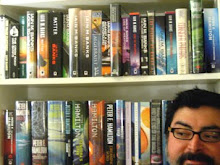
I've been meaning to post about all the SF & Fantasy related news I've come across.
Here goes.
Firstly, I attended NORWESCON (they currently have information up for 2011), the Northwest Science Fiction Convention where they announce the Philip K. Dick Award winner every year.
Now, contrary to the other major SF awards in the U.S., the Philip K. Dick Award is chosen by a small committee; the LOCUS award is voted on by the Magazine's readers, the HUGO Award is voted on by attendees of the World Science Fiction Convention (wherever it is held every year), and the NEBULA Award is chosen by members of the Science Fiction Writers of America. That's the first way this award is unique.
The second unique aspect is that it is an award given to paperback originals (trade or mass market). It's set up this way because during Philip K. Dick's lifetime, he was never published in hardback here in the U.S. (in Europe and England, where they 'got' his talent before we did, he had a healthy publishing history). Paperback originals have also traditionally been ignored by some of the more prestigious awards.
So because it is a small committee, voting on often overlooked books, the shortlist is a wonder to behold every year. The awards always surprises; it makes novels go up against short story collections and anthologies, and super-small presses are equally considered along with larger ones.
I was extremely happy in 2004 when a little known book, Life by Gwyneth Jones, published by a tiny local press Aqueduct Press, won the Award that year. The book deserved it, so did the publisher for taking a chance on an interesting topic.
The winner this year was BITTER ANGELS by C. L. Anderson... Nothing against the judges, or the winner, but I was pulling for Daryl Gregory's THE DEVIL'S ALPHABET (mainly because I loved his first novel, PANDEMONIUM so much).
The other major award announcements were the finalists for the Hugo Award:
Boneshaker, Cherie Priest (Tor)
The City & The City, China Miéville (Del Rey; Macmillan UK)
Julian Comstock: A Story of 22nd-Century America, Robert Charles Wilson (Tor)
Palimpsest, Catherynne M. Valente (Bantam Spectra)
Wake, Robert J. Sawyer (Ace; Penguin; Gollancz; Analog)
The Windup Girl, Paolo Bacigalupi (Night Shade)
and the Locus Magazine Award:
Science Fiction Novel
The Empress of Mars, Kage Baker (Subterranean; Tor)
Steal Across the Sky, Nancy Kress (Tor)
Boneshaker, Cherie Priest (Tor)
Galileo's Dream, Kim Stanley Robinson (HarperVoyager; Ballantine Spectra)
Julian Comstock: A Story of 22nd-Century America, Robert Charles Wilson (Tor)
Fantasy Novel
The City & The City, China Miéville (Del Rey; Macmillan UK)
Unseen Academicals, Terry Pratchett (Harper; Doubleday UK)
Drood, Dan Simmons (Little, Brown)
Palimpsest, Catherynne M. Valente (Bantam Spectra)
Finch, Jeff VanderMeer (Underland)
There's some overlap in both awards, but it's exciting since all the authors are extremely talented and if a person were to use these lists as a reading guide, they would have a great time.
Also at Norwescon, I attended a panel titled "Impact of Digital media", which was set up to discuss many of the issues dogging publishers today; Amazon, e-book pricing, etc. During the panel a gentleman named Ben made a statement that blew my mind wide open, to look directly at something that had been simmering in my mind for a while: he was referring to e-books and 'multi-media' books (on the horizon, getting closer thanks to the ipad and some of the things it can do with books). What he said was:
"We need to think of these as different things."
And then it came to me: We do need to think of these things as different; a book, an e-book, a multi-media book, an audio book. It's obvious with audio, but is it really? It's someone reading aloud a book word-for-word, in other words, rather than visually delivering the text, it is being delivered aurally. So in essence, the audio book is like a regular book. It's more tricky with e-books and multi-media books (mmbooks, for convenience). Arguments are raging across the net and in magazines about e-books not being aesthetically designed like books, the idea of mmbooks terrifies fans of the traditional book, but what if, what if:
We started to view all of these permutations as evolutionary branch-off points, like Neanderthals and Homo sapiens?
But you say, 'things' can't evolve. Yes they can. Not on their own, but in concert with humanity. I read a book a long time ago called "The Alphabet Versus the Goddess" which had some startling and exciting theories about literature and human evolution ( I won't go into them here), but the lesson I took away from it was: Whatever humans make, in turn, remakes us. Be it a car, a fabric, a book, a cellphone.
If we start to look at the book problem from this angle, we can begin to separate the divergent 'species' and allow them to evolve in separate directions. Film narrative is a distinct, but no less connected, off-shoot of narratives forged in literature; decades later it evolved enough to create its own narrative devices, which in turn wove their way into the novels of the 20th century.
Let's talk about e-books. But let's truly look at them divorced from the idea of the book
All these mediums are evolutionary branching off points from a original, an Ur-medium; the art of pure story-telling, around fires; each step--cave painting, hieroglyph, abstract alphabet, clay, papyrus, paper, scroll, etc--represents a shift in how stories are told. The book was not borne, Athena-like from Gutenberg's forge; its history is large and its future is ever-changing.
Rather than call this era the end of the book, I declare it the Golden Age, where, challenged by various other forms of story-telling, the book finally comes into its own, solidifies what it means to us, to our future, to our evolution as a species.
Friday, April 23, 2010

Friday, April 16, 2010
Introducing HASH; Concept Proofs
I first met Charles Cox through my co-worker Alicia, they'd just begun dating and she was very happy with him; when I met Charles, I understood why--an extremely gregarious, intelligent fellow and, as I was to find out, a man of many talents. Last year, as we set up the Press and The Espresso Book Machine, Charles and Alicia came by to see the new member of the Lake Forest Park community and to see how I was holding up. We fell into casual conversation about what the EBM means in terms of re-arranging the traditional publishing model, and Charles mentioned a book he'd written for NANOWRIMO and wondered idly if he should print a few copies. I didn't leap straight at him in excitement, but I began the conversation that, this past March, culminated in this:
 HASH was written in November, but it had been years in gestation; Charles had been familiar with the characters for a while, and it showed-- as I read the book, I felt that the characters were, 'lived in', real. Designing HASH was a joy because Charles let me play with fonts (4 of them!) and certain 'flourishes' in layout; it was also a joy because HASH is very kinetic, harkening back to the days of William Gibson and before, when ideas didn't have to be door-stopper novels or be book x of a series. It's a smart, lean book; funny and thoughtful. And I felt it deserves to be published.
BUT.
Charles didn't want to self-publish (that can sometimes be a full-time job of its own), but he was curious about an idea I had-- self-produced manuscripts, which I later renamed CONCEPT PROOFS.


BUT.
Charles didn't want to self-publish (that can sometimes be a full-time job of its own), but he was curious about an idea I had-- self-produced manuscripts, which I later renamed CONCEPT PROOFS.


My thinking is this: In this landscape of publishers trimming down editors, swallowing up other publishers and imprints, and more and more agents looking for that 'next big thing' and being less patient to grow an authors' careers (I'm not saying all agents are like this, but there is a trend.), it's harder and harder to get a foot in the door.
Even once you've made it as far as an agent, and, into a publisher for consideration, your book could die on the phrase "I don't know how to market this." On the one hand, the reason is bunk, on the other, publishing is a business, so they have to think in those terms. An agent or an editor must look at a manuscript and/or query letter and visualize possibilities; the kind of book that might come out of this double-spaced gathering of text.
The Concept Proof is an option for authors who want to take the chance to visualize how their book might look from a publisher; they can determine whether it draws heavily on genre book design or other, 'mainstream' design aspects (a cross-over book like Niffenegger's "The Time-Traveler's Wife", for example). So this is why we made HASH; I took Charles' novel, decided how I wanted it to look on the inside, while the multi-talented Charles (I said so earlier, remember?) designed his own cover, and the photos show what came out of it. Our hope is that we've done some of the conceptualizing for the prospective agent or publisher, and they'll be more open to considering it.
All that said, we know that we can't be sending the physical copy to everyone under the sun; most agents and/or publishers only take digital submissions. But it's a cozy little world out there in Publishingland, and who knows who you might run into at a party or convention?
Thursday, April 8, 2010
The Autumns of our Days; TAB, TAB, TAB, link, link, link
Why is it that as the days go by I feel guilty if I don't post at least once a week? I mean, it's not like you're all perched on the edge of your seat, waiting for my next ramblings, like some lovelorn soul waiting for that 'call', are you?
Anyhow, once again the Press has been in full production mode, and a good chunk of my casual time during office hours has been to train the indefatigable Autumn, who is now my most able and very welcome assistant. She runs the machine while I work on design, talk to clients,etc. She also helps coordinate the Press, clean up after my messy self, and is a great sounding board for design ideas. It was interesting to train Autumn, as I've been running the Press solo since we set up on November last year. When the technician was here, I was the only one fully trained and it was necessary-- there's so much to watch for, so many variable, that if two people were to train neither one would've absorbed the totality of what it takes to run the machine-- the technician would've had to cater to more than one learning style, speed-- meaning that they would have to backtrack often. When we created the Press, we envisioned a time when it would be running seven days a week, but to do that we'd have to train people. And I didn't know exactly how the structure of training would look like. Fortunately, Autumn is a quick study, and didn't laugh at me when I'd say things like "I want you to watch every book closely. Every book. Watch every part of the machine as it moves. Ask yourself why that part does what it does. Again and again. So that eventually, you'll be able to turn your back on the machine and you'll hear when something goes awry." Like some deranged Jedi, me.
So now Autumn runs the Press on at least one weekend day, and sometimes, later in the evening. And so we can meet our client's print runs in a timely fashion. And besides, it's nice to have another human around sometimes. It gets a bit lonely in this glass menagerie...
As I go about my day here at the Press, I come across articles either sent to me or through blogs I follow, or, the Hyperspace of the internet otherwise known as Twitter. I open a new tab for each of these, digest the information, and if it might stimulate a topic for a blog post I leave it up.
I'm currently looking at over 20 tabs in 2 windows. And that's after some culling and one brief mishap with firefox (I'm now using Chrome to spur my forays into the digi-aether). Don't worry, I'm not going to dump them all on you (that is what Twitter is for). I'll have lots more to say about recent developments with the Press, the books we've published, and other book-related events and concerns. For now, I'll run through a few that are important to share.
I remember when news that "Hapworth 16, 1924" by J. D. Salinger, was to be published in book form. It was 1997, and I was still at The Elliott Bay Book Company; we had an ancient and cluttered computer inventory system, and all our special orders were carefully and copiously handwritten. I remember being shown the fistful of orders waiting for the book (which was originally printed in The New Yorker)--sadly, the book never came out, but those orders stayed active for years, symbol of blind hope. Now, the true story of the books (non) publication has been written by the man who tried to publish it. I'm sure he dutifully and respectfully waited until Salinger's death to write about it. It's fascinating, and heartbreaking, especially from the point of view of someone like me who loves to design books, and loves seeing them get printed, and loves scooping some unique project. You should read it.
The Unicorn has landed. Ok, not a real unicorn, but the iPad. Sure, you're sick of hearing about it by now, but I move at a snail's pace with the bloggery so you have to be patient with me. First, this excellent article by Stephen Fry, on interviewing Steve Jobs, and Fry's first moment with an iPad. What is unique about this article over the glut out there is he mentions the sorely-missed Douglas Adams, who was, more that a great novelist, an advocate of Apple from its inception, and fiercely curious about the potential of multi-media and technology in terms of storytelling possibilities (I fondly recall the Hitchhiker's text-based game)... And the very weekend of the iPad's release, this bit of 'performance art' --teens destroy an iPad in front of a Best Buy. On one level, it's a brilliant piece of social statement--about consumerism, about technology overwhelming our lives and becoming fetishized--but I was bothered by some of what one teen said: it's not that he wanted to 'do it first', but when asked whether he hated Apple, he responding by citing all the Apple machines his family owned already including 2 other iPads.... Cory Doctorow, author of the amazing "Little Brother", an outspoken proponent of open source philosophy, flexible copyright laws, has written about his distaste for the iPad & its 'closed system' and dumbing down of computer literacy in the masses. I'm not sure I entirely agree with his statements, but he's an agile thinker and always stimulates healthy debate.
E-madness! So Amazon continues to sulk, albeit more surreptitiously. Moby Lives blog writes about Amazon's latest move- blaming the price of an e-book in the publisher right on the webpage. I know Amazon's probably doing the "wha? me? huh?" shrug about the intentions of such a maneuver, but it's clear to me (and Moby Lives) that Amazon's attempting to cause a customer uprising. Take to the digital streets, rebels! Sing with me now: 'let Amazon run the publishing industry--er. Cheaper books now!'. yes Amazon. I'm watching you. ::does the fingers to eyes gesture:: ...This interesting post from Publishing Perspectives asks the question of bundling--e-book and physical book. You buy the physical book, you get a free (or at least highly reduced in price) download. All these arguments about e-book pricing would fade quickly if a bundling system was created. Say 'Book X' is 15.99, or 18.99 in a bundled edition. It works in the music industry where some albums are sold only as vinyl and come with a web-link and download code so you can get the digital versions of the songs. It's an idea worth resurrecting. Publishing industry, are you listening?... Over at the New York Times page, Randy Cohen, writing as The Ethicist has received flak over some advice about downloading a pirated version of a book they've already bought in physical form. Essentially, he didn't see an issue with downloading a copy of a book you've already paid for. The blogosphere is on fire about this, primarily because of the sensitive nature of the e-book industry right now, but John Scalzi has a beautifully apt post about the controversy from the author's perspective, and he's supporting Cohen's advice (so am I, see the 'bundled' link above), while carefully outlining the real issues at hand. I think the e-book debacle that's been growing is leading to the big elephant in the room: International Rights, and the growing awareness amongst authors about the minutiae in their contracts. Not everybody's happy with the control publishers have.
Retro in a Futuro way. So we run a Press, right? With this mechanical-thingy we've named 'Ginger' that makes insta-books. Physical books. eeeewwww! Ur bookz iz in my hans dirty! We should be hopping on this e-book bandwagon, yeah? And to top it off, we make broadsides to compliment the publication of certain books. Physical. Tangible. Using an actual letter press (independently run by Seattle Artist Amy Redmond). Argh! What are you, Luddites? I hear you scream. No. We just dig the spirit of creation that leads to writing books, to making them, to the art that goes on the covers, the tactile nature of the printed book. Over at the Third Place Books blog (New! Stop by and say hello!) there's a post about the most recent broadside for William Vollman's latest book "Kissing the Mask". I love the broadsides; running my hand lightly over the indentation of the text, the hand-made paper, the aesthetic elegance of the designs. While the purpose of broadsides is to get customers to buy the book from us, we hope that people also appreciate the quality and resonance of such an item in the daily life of a book lover. If you're ever at the store, check out our previous broadsides hanging on the walls of the Rare and Collectible area, and in some cases some of these pieces are still available for purchase (if you ask nicely).
My next post will be dedicated to the more SF&F side of things; the annual Seattle SF convention Norwescon, the Hugo Awards, and a special Third Place Press Project...
Anyhow, once again the Press has been in full production mode, and a good chunk of my casual time during office hours has been to train the indefatigable Autumn, who is now my most able and very welcome assistant. She runs the machine while I work on design, talk to clients,etc. She also helps coordinate the Press, clean up after my messy self, and is a great sounding board for design ideas. It was interesting to train Autumn, as I've been running the Press solo since we set up on November last year. When the technician was here, I was the only one fully trained and it was necessary-- there's so much to watch for, so many variable, that if two people were to train neither one would've absorbed the totality of what it takes to run the machine-- the technician would've had to cater to more than one learning style, speed-- meaning that they would have to backtrack often. When we created the Press, we envisioned a time when it would be running seven days a week, but to do that we'd have to train people. And I didn't know exactly how the structure of training would look like. Fortunately, Autumn is a quick study, and didn't laugh at me when I'd say things like "I want you to watch every book closely. Every book. Watch every part of the machine as it moves. Ask yourself why that part does what it does. Again and again. So that eventually, you'll be able to turn your back on the machine and you'll hear when something goes awry." Like some deranged Jedi, me.
So now Autumn runs the Press on at least one weekend day, and sometimes, later in the evening. And so we can meet our client's print runs in a timely fashion. And besides, it's nice to have another human around sometimes. It gets a bit lonely in this glass menagerie...
As I go about my day here at the Press, I come across articles either sent to me or through blogs I follow, or, the Hyperspace of the internet otherwise known as Twitter. I open a new tab for each of these, digest the information, and if it might stimulate a topic for a blog post I leave it up.
I'm currently looking at over 20 tabs in 2 windows. And that's after some culling and one brief mishap with firefox (I'm now using Chrome to spur my forays into the digi-aether). Don't worry, I'm not going to dump them all on you (that is what Twitter is for). I'll have lots more to say about recent developments with the Press, the books we've published, and other book-related events and concerns. For now, I'll run through a few that are important to share.
I remember when news that "Hapworth 16, 1924" by J. D. Salinger, was to be published in book form. It was 1997, and I was still at The Elliott Bay Book Company; we had an ancient and cluttered computer inventory system, and all our special orders were carefully and copiously handwritten. I remember being shown the fistful of orders waiting for the book (which was originally printed in The New Yorker)--sadly, the book never came out, but those orders stayed active for years, symbol of blind hope. Now, the true story of the books (non) publication has been written by the man who tried to publish it. I'm sure he dutifully and respectfully waited until Salinger's death to write about it. It's fascinating, and heartbreaking, especially from the point of view of someone like me who loves to design books, and loves seeing them get printed, and loves scooping some unique project. You should read it.
The Unicorn has landed. Ok, not a real unicorn, but the iPad. Sure, you're sick of hearing about it by now, but I move at a snail's pace with the bloggery so you have to be patient with me. First, this excellent article by Stephen Fry, on interviewing Steve Jobs, and Fry's first moment with an iPad. What is unique about this article over the glut out there is he mentions the sorely-missed Douglas Adams, who was, more that a great novelist, an advocate of Apple from its inception, and fiercely curious about the potential of multi-media and technology in terms of storytelling possibilities (I fondly recall the Hitchhiker's text-based game)... And the very weekend of the iPad's release, this bit of 'performance art' --teens destroy an iPad in front of a Best Buy. On one level, it's a brilliant piece of social statement--about consumerism, about technology overwhelming our lives and becoming fetishized--but I was bothered by some of what one teen said: it's not that he wanted to 'do it first', but when asked whether he hated Apple, he responding by citing all the Apple machines his family owned already including 2 other iPads.... Cory Doctorow, author of the amazing "Little Brother", an outspoken proponent of open source philosophy, flexible copyright laws, has written about his distaste for the iPad & its 'closed system' and dumbing down of computer literacy in the masses. I'm not sure I entirely agree with his statements, but he's an agile thinker and always stimulates healthy debate.
E-madness! So Amazon continues to sulk, albeit more surreptitiously. Moby Lives blog writes about Amazon's latest move- blaming the price of an e-book in the publisher right on the webpage. I know Amazon's probably doing the "wha? me? huh?" shrug about the intentions of such a maneuver, but it's clear to me (and Moby Lives) that Amazon's attempting to cause a customer uprising. Take to the digital streets, rebels! Sing with me now: 'let Amazon run the publishing industry--er. Cheaper books now!'. yes Amazon. I'm watching you. ::does the fingers to eyes gesture:: ...This interesting post from Publishing Perspectives asks the question of bundling--e-book and physical book. You buy the physical book, you get a free (or at least highly reduced in price) download. All these arguments about e-book pricing would fade quickly if a bundling system was created. Say 'Book X' is 15.99, or 18.99 in a bundled edition. It works in the music industry where some albums are sold only as vinyl and come with a web-link and download code so you can get the digital versions of the songs. It's an idea worth resurrecting. Publishing industry, are you listening?... Over at the New York Times page, Randy Cohen, writing as The Ethicist has received flak over some advice about downloading a pirated version of a book they've already bought in physical form. Essentially, he didn't see an issue with downloading a copy of a book you've already paid for. The blogosphere is on fire about this, primarily because of the sensitive nature of the e-book industry right now, but John Scalzi has a beautifully apt post about the controversy from the author's perspective, and he's supporting Cohen's advice (so am I, see the 'bundled' link above), while carefully outlining the real issues at hand. I think the e-book debacle that's been growing is leading to the big elephant in the room: International Rights, and the growing awareness amongst authors about the minutiae in their contracts. Not everybody's happy with the control publishers have.
Retro in a Futuro way. So we run a Press, right? With this mechanical-thingy we've named 'Ginger' that makes insta-books. Physical books. eeeewwww! Ur bookz iz in my hans dirty! We should be hopping on this e-book bandwagon, yeah? And to top it off, we make broadsides to compliment the publication of certain books. Physical. Tangible. Using an actual letter press (independently run by Seattle Artist Amy Redmond). Argh! What are you, Luddites? I hear you scream. No. We just dig the spirit of creation that leads to writing books, to making them, to the art that goes on the covers, the tactile nature of the printed book. Over at the Third Place Books blog (New! Stop by and say hello!) there's a post about the most recent broadside for William Vollman's latest book "Kissing the Mask". I love the broadsides; running my hand lightly over the indentation of the text, the hand-made paper, the aesthetic elegance of the designs. While the purpose of broadsides is to get customers to buy the book from us, we hope that people also appreciate the quality and resonance of such an item in the daily life of a book lover. If you're ever at the store, check out our previous broadsides hanging on the walls of the Rare and Collectible area, and in some cases some of these pieces are still available for purchase (if you ask nicely).
My next post will be dedicated to the more SF&F side of things; the annual Seattle SF convention Norwescon, the Hugo Awards, and a special Third Place Press Project...
Friday, March 12, 2010
Books! Books! Books! Ahhhmazonnnnn. Again? The Twitter-blogo-wrangle
Yep, another delay in blog posts, but with reason: Busy, busy making books, designing books, and coordinating the Press.
As the client list grows for Third Place Press, I'm having to farm out some services so that we can get our client's projects up and printing quickly. These past 2 weeks I've finalized the family Fictional memoir, "Ruby", by Wilma Wilson. Currently this is more of an intimate printing--family & acquaintances-- but it's a very large extended family, and the occasion for the book is that the author is turning 94! Her daughter corralled the whole project into shape and now her family is calling her up to order copies.
And just in time for The Emerald City Comicon, we unveil our super-secret book project:

We're pretty happy with the outcome-- Roberta Gregory's collection of her comic book narratives previously published in the "Naughty Bits" comic book series published by Fantagraphics Books, as well as some original pieces. The potential of the EBM is not limited to literature, the rise of the independent comic book artist on the web and the real world represents a fundamental shift in the way we used to tell our stories; I'm not saying grandiose or apocalyptic stuff like "Literature is Dead!" or "It's the End of the Novel!" I'm a firm believer in the healthy co-existence of all these forms of storytelling, and I'm hoping to get more comic book artists to see the potential of the machine in regards to their work-- the ease of production, low print runs, low costs. I know there are many artists out there right now who believe that publishing their work is either a pipe-dream or very far into the future.
I say the time is NOW.
Whimsy:
It appears that Ben Greeman writing at Mcsweeneys.net, via Galleycat, proposed a new savior for the Publishing Industry... No, it's now e-books, nor p-books (as all the techies are calling real books), nor is it the multi-media-predicted-by-Neal-Stephenson-in-The-Diamond-Age madness that's coming from publishers very soon. It's-- 3-D Type! Wooooooo! Apparently the twitter-sphere and blogo-verse went Code Red for a day or two before it was revealed that 3*TYPE was satire. I for one was relieved. I really think it would be crazy to set a Chuck Palahniuk book in 3-D type, to cite just one example...
And Amazon once again, acting like a dance partner with two left feet (one from a donkey, one from a gorilla), ended up stepping on the toes of Comic book fans and the publishers. The fiasco essentially involved another computer glitch (disgruntled employee, anyone?) that set the prices of high-end graphic novels to $14.99 across the board. Well, obviously the fans mobilized and ordered multiple items, often clocking in at over $100 dollars per person. Amazon back-pedaled, canceled most orders, then in what seemed like over-kill took the buy buttons away for several days. Which made creators & publishers mad, and created a chorus of "Now's the time to go to a brick and mortar comic store."...This all sounds familiar. And in two weeks people will be back to sheeping their way back to Amazon, and comic book stores will be back to struggling to compete. Sigh.
I love the New Scientist for its witty way of tweeting articles, here are some examples of the the treasures that clicking on their links will get you...
Two bits of delightful internet absurdity, first via Nick Harkaway, writer at large, and then by Paul Constant, Books Editor of The Stranger in Seattle.
Have a great weekend!
As the client list grows for Third Place Press, I'm having to farm out some services so that we can get our client's projects up and printing quickly. These past 2 weeks I've finalized the family Fictional memoir, "Ruby", by Wilma Wilson. Currently this is more of an intimate printing--family & acquaintances-- but it's a very large extended family, and the occasion for the book is that the author is turning 94! Her daughter corralled the whole project into shape and now her family is calling her up to order copies.
And just in time for The Emerald City Comicon, we unveil our super-secret book project:

We're pretty happy with the outcome-- Roberta Gregory's collection of her comic book narratives previously published in the "Naughty Bits" comic book series published by Fantagraphics Books, as well as some original pieces. The potential of the EBM is not limited to literature, the rise of the independent comic book artist on the web and the real world represents a fundamental shift in the way we used to tell our stories; I'm not saying grandiose or apocalyptic stuff like "Literature is Dead!" or "It's the End of the Novel!" I'm a firm believer in the healthy co-existence of all these forms of storytelling, and I'm hoping to get more comic book artists to see the potential of the machine in regards to their work-- the ease of production, low print runs, low costs. I know there are many artists out there right now who believe that publishing their work is either a pipe-dream or very far into the future.
I say the time is NOW.
Whimsy:
It appears that Ben Greeman writing at Mcsweeneys.net, via Galleycat, proposed a new savior for the Publishing Industry... No, it's now e-books, nor p-books (as all the techies are calling real books), nor is it the multi-media-predicted-by-Neal-Stephenson-in-The-Diamond-Age madness that's coming from publishers very soon. It's-- 3-D Type! Wooooooo! Apparently the twitter-sphere and blogo-verse went Code Red for a day or two before it was revealed that 3*TYPE was satire. I for one was relieved. I really think it would be crazy to set a Chuck Palahniuk book in 3-D type, to cite just one example...
And Amazon once again, acting like a dance partner with two left feet (one from a donkey, one from a gorilla), ended up stepping on the toes of Comic book fans and the publishers. The fiasco essentially involved another computer glitch (disgruntled employee, anyone?) that set the prices of high-end graphic novels to $14.99 across the board. Well, obviously the fans mobilized and ordered multiple items, often clocking in at over $100 dollars per person. Amazon back-pedaled, canceled most orders, then in what seemed like over-kill took the buy buttons away for several days. Which made creators & publishers mad, and created a chorus of "Now's the time to go to a brick and mortar comic store."...This all sounds familiar. And in two weeks people will be back to sheeping their way back to Amazon, and comic book stores will be back to struggling to compete. Sigh.
I love the New Scientist for its witty way of tweeting articles, here are some examples of the the treasures that clicking on their links will get you...
Two bits of delightful internet absurdity, first via Nick Harkaway, writer at large, and then by Paul Constant, Books Editor of The Stranger in Seattle.
Have a great weekend!
Wednesday, February 17, 2010
The Bionic Woman; Verne (Jules) in Reverse; I have a beef to pick with the end of the world
Ginger is in the middle of getting upgrades (no, I won't make reference to cosmetic surgery), and I've taken to thinking of the process as what they did to Jaime Somers in the Bionic Woman. Fitter, Better, Smarter, Stronger. My preference is to think about the short-lived remake rather than the original (I have a thing for that Michelle Ryan-- rowrrr!).
I watched the technicians for a bit, dismantling plexi-glass, mountings... but when they pulled out the drills I had to leave. It was all a bit too intimate. Like watching major surgery on a relative. In just over 24 hours Ginger will be up and running again with new features and doo-hickeys (yes, that is a technical term) that hopefully won't take long to adjust to. It was odd to not have access to Ginger the whole day, like ghost limb syndrome or something. So I wandered over to the bookstore and did a thorough check on my only section (Graphica, which, due to the hectic nature of TPPress of late, I haven't taken care of properly). When I came back later in the afternoon, the Techs were gone, off to Village Books to help the operator fix a few glitches on her machine. This gave me an opportunity to quietly work on more book design projects, have a meeting with an author I'm excited to be working with (more details as they unfold), catch up on Twitter and find myself being followed (on Twitter, not in real life) by rising literary star Nick Harkaway . Cool.
Jules Verne. Several weeks ago I received an email from J. who politely asked me if I could print the book attached to the link below his sentence. I did and was very surprised by what was there: "Journey to the Center of the Earth". So what? you might say? It's in Hebrew. Printed in 1878. Published in Poland, rebound in the 1950s in Charlestown, Mass., ultimately residing in the Harvard University library. Wow. After several emails back and forth, I contacted Google, who O.K'd the one-off printing.
But I was feeling cocky. I told J. that not only would I make the book for him, I would print it in the Hebrew fashion (Hebrew is read from right to left). So after a couple of weeks of dabbling, I managed to make it. You'll notice two books in the photo below, and that's because during the process J. wanted me to print "20,000 Leagues Under the Sea", in Hebrew, from 1878. The original scans were a tad spotty, the Hebrew type was a bit small, but for a scholar, easy access to a work like this more than makes up for the roughness of the PDF.

Post-apocalyptic this, Post-apocalyptic that.
O.K., great. another SF trope is being embraced on a large scale. "The Road" by Cormac McCarthy is but one example of the hot new trend in literature: _____ - Apocalypse (Post-, Zombie-, Vampire-, Barbie-). And this article chronicles the increasing speed that YA publishers and their readers are eating up the books.
My problem is that most of these are not Post-Apocalyptic (dictionary: predicting or presaging imminent disaster and total or universal destruction.). Now I can see, growing up in the 1980s that Post-Apocalyptic referred to a Nuclear exchange, which would bring about the dictionary definition above, but the vast bulk of books being published don't fit the bill.
Ahhh! An EMP pulse destroys all electronics! Post-Apocalyptic!
An earthquake destroys most Californian cities! Post-Apocalyptic!
Vampires come out of the dark and battle humans! Post-Apocalyptic!...
Not really. Ok, maybe the last one is close. I think we need to refer to most of these books as Post-Society novels. The deconstruction of societal norms does not an Apocalypse make. Even global events don't neatly qualify as Apocalyptic conditions.
I'm a big believer in talking about writing in the correct way, and even scholars make the mistake of talking 'genre' when they should be talking 'technique.' It's a meme-thing: once 'genre' slips out of a person's mouth, the people in the room shift in their seats and develop walls (even at SF & Fantasy conventions this occurs); it becomes a 'which genre is better' dialogue and nobody ever learns anything.
The point I'm always making is that the hottest writers out there (including Mr. McCarthy) are hot because they are breaking the pre-established literary divisions by using any tool in the writer's kit-bag to tell their story. In the case of "The Road", McCarthy realized that he needed the elements of a 'dystopian/apocalyptic', dare I say it, Post-societal story, to get to the essence of the emotional reactions he needed from his characters, and to properly address the themes he was ruminating upon.
So here's to the flood of post-society novels! Long may they crumble... combust...devour...um....
I watched the technicians for a bit, dismantling plexi-glass, mountings... but when they pulled out the drills I had to leave. It was all a bit too intimate. Like watching major surgery on a relative. In just over 24 hours Ginger will be up and running again with new features and doo-hickeys (yes, that is a technical term) that hopefully won't take long to adjust to. It was odd to not have access to Ginger the whole day, like ghost limb syndrome or something. So I wandered over to the bookstore and did a thorough check on my only section (Graphica, which, due to the hectic nature of TPPress of late, I haven't taken care of properly). When I came back later in the afternoon, the Techs were gone, off to Village Books to help the operator fix a few glitches on her machine. This gave me an opportunity to quietly work on more book design projects, have a meeting with an author I'm excited to be working with (more details as they unfold), catch up on Twitter and find myself being followed (on Twitter, not in real life) by rising literary star Nick Harkaway . Cool.
Jules Verne. Several weeks ago I received an email from J. who politely asked me if I could print the book attached to the link below his sentence. I did and was very surprised by what was there: "Journey to the Center of the Earth". So what? you might say? It's in Hebrew. Printed in 1878. Published in Poland, rebound in the 1950s in Charlestown, Mass., ultimately residing in the Harvard University library. Wow. After several emails back and forth, I contacted Google, who O.K'd the one-off printing.
But I was feeling cocky. I told J. that not only would I make the book for him, I would print it in the Hebrew fashion (Hebrew is read from right to left). So after a couple of weeks of dabbling, I managed to make it. You'll notice two books in the photo below, and that's because during the process J. wanted me to print "20,000 Leagues Under the Sea", in Hebrew, from 1878. The original scans were a tad spotty, the Hebrew type was a bit small, but for a scholar, easy access to a work like this more than makes up for the roughness of the PDF.

Post-apocalyptic this, Post-apocalyptic that.
O.K., great. another SF trope is being embraced on a large scale. "The Road" by Cormac McCarthy is but one example of the hot new trend in literature: _____ - Apocalypse (Post-, Zombie-, Vampire-, Barbie-). And this article chronicles the increasing speed that YA publishers and their readers are eating up the books.
My problem is that most of these are not Post-Apocalyptic (dictionary: predicting or presaging imminent disaster and total or universal destruction.). Now I can see, growing up in the 1980s that Post-Apocalyptic referred to a Nuclear exchange, which would bring about the dictionary definition above, but the vast bulk of books being published don't fit the bill.
Ahhh! An EMP pulse destroys all electronics! Post-Apocalyptic!
An earthquake destroys most Californian cities! Post-Apocalyptic!
Vampires come out of the dark and battle humans! Post-Apocalyptic!...
Not really. Ok, maybe the last one is close. I think we need to refer to most of these books as Post-Society novels. The deconstruction of societal norms does not an Apocalypse make. Even global events don't neatly qualify as Apocalyptic conditions.
I'm a big believer in talking about writing in the correct way, and even scholars make the mistake of talking 'genre' when they should be talking 'technique.' It's a meme-thing: once 'genre' slips out of a person's mouth, the people in the room shift in their seats and develop walls (even at SF & Fantasy conventions this occurs); it becomes a 'which genre is better' dialogue and nobody ever learns anything.
The point I'm always making is that the hottest writers out there (including Mr. McCarthy) are hot because they are breaking the pre-established literary divisions by using any tool in the writer's kit-bag to tell their story. In the case of "The Road", McCarthy realized that he needed the elements of a 'dystopian/apocalyptic', dare I say it, Post-societal story, to get to the essence of the emotional reactions he needed from his characters, and to properly address the themes he was ruminating upon.
So here's to the flood of post-society novels! Long may they crumble... combust...devour...um....
Friday, February 12, 2010
Book-a-palooza; Makin' Da Books; Takin' Da Books Away; Google-gobble; Douchy Ads
I know I keep saying this in almost every post, but dang, has it been busy lately!
That's a good thing, though. Unfortunately, it means less blog posts...
Or at least posts with the kitchen sink thrown in.
A wrap up of the steady flow of database books: French-language "Dangerous Liasons", a paranormal thriller "Blue Moon", the Libertarian classic from the 1990s "From Freedom to Slavery", "Studies on Fermentation" by Louis Pasteur (Beer is the mind-killer!), "The Charles Fort Reader" (the Fox Mulder of his day), "William Tyndale's Five Books of Moses" (big, big book... Moses apparently had a lot to say), "The Collected Articles of Frederic Douglass" (plus a second work)... The couple that I wrote about in December, came back for a massive Google order, Some Books on Boxing, theatre, "A Dictionary of Slang, Jargon, and Cant: Embracing English, American, and Anglo-Indian Slang, Pidgin English, Tinker's Jargon , and Other Irregular Phraseology" (2 Volumes), and several more.
My co-workers are also contributing to the variety of books discovered on Google: "Observations of Sir Richard Hawkins" was ordered by a Greg, who is a descendant of the Hawkins line and has of late discovered that his family history is littered with the fingerprints of adventurers and explorers. Lucky Sod. Mine were con-men and farmers... Adam, who lead me to write about the fate of an Alan Lomax book and the state of copyright, has been ordering books on early American Folk and Minstrelry, books buried in time, with vital clues for musicians like Adam (who plays in a duo called The Whiskey Swillers) who want to revive these songs. So much to discover yet!
I've been working furiously on several book designs for clients; a few are about to be finalized, while some are queued up next. I won't talk specifics but I will mention the dazzling variety in just these handful of authors: an Alternate History novel; a fiction about being a nurse and appreciating the fullness of life in middle age; a book on knife collecting with dozens of photos; a collection of hunting escapades; a fictionalized biography of a favored and adventurous family Aunt... Each one brings a unique design challenge, and I love working on each one equally... And as of this writing, I've done layout for 2 books (totaling 800 pages) just this week. Phew. And they keep coming.
I've been on Twitter several weeks now, and I find that while my time has been busy with running the press, Twitter offers me that brief moment to cast a thought, a link, into the universe. So while I may be silent on the blog, Twitter has a steady drizzle of errant thoughts flowing through it @3rdplacepress...
Amazon and Macmillan. That happened since my last post... The meeting between the two industry giants took place on the day Apple debuted its Unicorn. Amazon and Macmillan were at a stalemate over e-book pricing and the publisher walked away from the meeting feeling at an impasse. Amazon on the other hand, walked over to its wizz-bang-doodle Oz machine and hit a button (well, actually took it away) effectively neutering Macmillan's titles on the Amazon site. Such a sulky, bully thing to do. And John Scalzi had the best summary of the events and why Amazon was in the wrong, and why, even after events spun out of control, their media department's reaction was brutish at best. I certainly have my opinions of Amazon (which go waaaay back to 1996-7), so I won't rehash them here. Essentially, I know Amazon feels the heat over the announcement of Apples ibookstore in tandem with the Unicorn; I don't pity them, since, from day one, their Kindle strategy has been to be as proprietary as possible and totally dominate the emerging e-book market-- a Reader (Kindle) that only reads one format (Kindle format). Months later, people were still reading e-books (in various formats) on the iPhone, so a Kindle App was grudgingly released to the public. The second Kindle version came out, right when at least 10 other companies announced their own e-readers (including the god-awfully-named Vook from Barnes and Noble), most of which were open-format. Suddenly market control was slipping out of Amazon's hands and voila! that fateful meeting and the subsequent behavior and backlash. But to be fair, Amazon's not the only large company to flinch and overreact. Don't even get me started on the 'new' Facebook format (coincidentally widely released the day Google Buzz went live)...
Speaking of Google: they continue to expand the database of titles available, with Stanford recently agreeing to let Google list their titles. Regardless, Google is facing tough opposition to it's digitization program, which I'm on the fence about. On the one hand, I see the benefits of having access to those millions of forgotten, public domain titles; on the other hand, due to the blanket scanning of titles in libraries, Google now has access to digital editions of works by authors still alive. I know Google's created a nonprofit Book Rights Registry in order to clarify and alleviate many of the authors concerns. So, um. They're trying? A decent summary of events (including the dissenting authors and those who agreed) can be found here.
Whimsy: R.I.P (Rest in Public) J.D. Salinger. The world will soon be inundated with Salinger-fest. Though this film-maker's work will probably be the most genuine, least likely-to-cash-in-on-the-writer.
An awesome interview with a 'street' scientist with the brilliant quote: "I'm not a Rock Scientist. But then again, Rocket Science is just plumbing with math."
When I watched the Superbowl (the only time I watch NFL), the Dodge Ad that came on left me angry, and I'm a guy! The backlash from women was strong, and often funny. My main problem with this ad is that it preys on outdated gender stereotypes, like this horrendous humor book called "Porn for Women" which depicts men doing things like ironing, washing the dishes, vacuuming, being considerate. Har, Har, very funny. Let's tell women we'll only be neat and grown-up, and responsible because we want sex, or a new car. I like to iron (it relaxes me), I like to clean up after myself, and I'm considerate because it's what adults do. Regardless of gender. I know women who love to work on cars, climb rock walls, and playfully oggle men at bars... So what? Let us be what our inclinations guide us to be. Stuff it, Dodge (and the Mad Men at that Ad agency who thought it up)!
Finally, as the weekend approaches, all I have to say is: Kitchen Sink...
That's a good thing, though. Unfortunately, it means less blog posts...
Or at least posts with the kitchen sink thrown in.
A wrap up of the steady flow of database books: French-language "Dangerous Liasons", a paranormal thriller "Blue Moon", the Libertarian classic from the 1990s "From Freedom to Slavery", "Studies on Fermentation" by Louis Pasteur (Beer is the mind-killer!), "The Charles Fort Reader" (the Fox Mulder of his day), "William Tyndale's Five Books of Moses" (big, big book... Moses apparently had a lot to say), "The Collected Articles of Frederic Douglass" (plus a second work)... The couple that I wrote about in December, came back for a massive Google order, Some Books on Boxing, theatre, "A Dictionary of Slang, Jargon, and Cant: Embracing English, American, and Anglo-Indian Slang, Pidgin English, Tinker's Jargon , and Other Irregular Phraseology" (2 Volumes), and several more.
My co-workers are also contributing to the variety of books discovered on Google: "Observations of Sir Richard Hawkins" was ordered by a Greg, who is a descendant of the Hawkins line and has of late discovered that his family history is littered with the fingerprints of adventurers and explorers. Lucky Sod. Mine were con-men and farmers... Adam, who lead me to write about the fate of an Alan Lomax book and the state of copyright, has been ordering books on early American Folk and Minstrelry, books buried in time, with vital clues for musicians like Adam (who plays in a duo called The Whiskey Swillers) who want to revive these songs. So much to discover yet!
I've been working furiously on several book designs for clients; a few are about to be finalized, while some are queued up next. I won't talk specifics but I will mention the dazzling variety in just these handful of authors: an Alternate History novel; a fiction about being a nurse and appreciating the fullness of life in middle age; a book on knife collecting with dozens of photos; a collection of hunting escapades; a fictionalized biography of a favored and adventurous family Aunt... Each one brings a unique design challenge, and I love working on each one equally... And as of this writing, I've done layout for 2 books (totaling 800 pages) just this week. Phew. And they keep coming.
I've been on Twitter several weeks now, and I find that while my time has been busy with running the press, Twitter offers me that brief moment to cast a thought, a link, into the universe. So while I may be silent on the blog, Twitter has a steady drizzle of errant thoughts flowing through it @3rdplacepress...
Amazon and Macmillan. That happened since my last post... The meeting between the two industry giants took place on the day Apple debuted its Unicorn. Amazon and Macmillan were at a stalemate over e-book pricing and the publisher walked away from the meeting feeling at an impasse. Amazon on the other hand, walked over to its wizz-bang-doodle Oz machine and hit a button (well, actually took it away) effectively neutering Macmillan's titles on the Amazon site. Such a sulky, bully thing to do. And John Scalzi had the best summary of the events and why Amazon was in the wrong, and why, even after events spun out of control, their media department's reaction was brutish at best. I certainly have my opinions of Amazon (which go waaaay back to 1996-7), so I won't rehash them here. Essentially, I know Amazon feels the heat over the announcement of Apples ibookstore in tandem with the Unicorn; I don't pity them, since, from day one, their Kindle strategy has been to be as proprietary as possible and totally dominate the emerging e-book market-- a Reader (Kindle) that only reads one format (Kindle format). Months later, people were still reading e-books (in various formats) on the iPhone, so a Kindle App was grudgingly released to the public. The second Kindle version came out, right when at least 10 other companies announced their own e-readers (including the god-awfully-named Vook from Barnes and Noble), most of which were open-format. Suddenly market control was slipping out of Amazon's hands and voila! that fateful meeting and the subsequent behavior and backlash. But to be fair, Amazon's not the only large company to flinch and overreact. Don't even get me started on the 'new' Facebook format (coincidentally widely released the day Google Buzz went live)...
Speaking of Google: they continue to expand the database of titles available, with Stanford recently agreeing to let Google list their titles. Regardless, Google is facing tough opposition to it's digitization program, which I'm on the fence about. On the one hand, I see the benefits of having access to those millions of forgotten, public domain titles; on the other hand, due to the blanket scanning of titles in libraries, Google now has access to digital editions of works by authors still alive. I know Google's created a nonprofit Book Rights Registry in order to clarify and alleviate many of the authors concerns. So, um. They're trying? A decent summary of events (including the dissenting authors and those who agreed) can be found here.
Whimsy: R.I.P (Rest in Public) J.D. Salinger. The world will soon be inundated with Salinger-fest. Though this film-maker's work will probably be the most genuine, least likely-to-cash-in-on-the-writer.
An awesome interview with a 'street' scientist with the brilliant quote: "I'm not a Rock Scientist. But then again, Rocket Science is just plumbing with math."
When I watched the Superbowl (the only time I watch NFL), the Dodge Ad that came on left me angry, and I'm a guy! The backlash from women was strong, and often funny. My main problem with this ad is that it preys on outdated gender stereotypes, like this horrendous humor book called "Porn for Women" which depicts men doing things like ironing, washing the dishes, vacuuming, being considerate. Har, Har, very funny. Let's tell women we'll only be neat and grown-up, and responsible because we want sex, or a new car. I like to iron (it relaxes me), I like to clean up after myself, and I'm considerate because it's what adults do. Regardless of gender. I know women who love to work on cars, climb rock walls, and playfully oggle men at bars... So what? Let us be what our inclinations guide us to be. Stuff it, Dodge (and the Mad Men at that Ad agency who thought it up)!
Finally, as the weekend approaches, all I have to say is: Kitchen Sink...
Friday, January 29, 2010
Haiti; the Unicorn; Librarians
Catching up on the events of the past week, I need to mention that Third Place Press (along with the University of Washington Bookstore, Harvard Bookstore, and Schuler Books and Music) was commissioned by On Demand Books to contribute a unique piece of humanitarian aid:


Each of us was asked by a medical organization to contribute this book "Haitan Creole (Kreyol)-English Pocket medical dictionary" to redistribute to all the aid-workers and medical professionals helping save lives.The whole process to less that 5 days from the initial email requests!
It's and odd project; one that 5 years ago you wouldn't be able to wrap your mind around, but exciting nevertheless. To be able to print books through the EBM is a joy; to do so and help (in a small way) save the lives of others is astounding. I'm hoping the books get into the right hands. And I know that if they need more, we're ready.
The Apple iPad (heretofore dubbed 'the Unicorn' by me) caused quite a tizzy throughout the internet mid-week with Steve Jobs' presentation. I've been thinking about this device since the first rumors surfaced several years ago (relating to an order placed for 10 inch touch-screens from the Chinese manufacturer). When I saw the Unicorn unveiled, I wasn't surprised, wasn't disappointed, but was rather, quietly pleased. It's exactly as I'd imagined. No more, no less. And I know it'll evolve; all Apple products do. I know the main thing Apple did with its release was to force its competitors to rethink their concept of a netbook, much like they caused a philosophical shift in the evolution of smart phones.
The haters pounced immediately, whining about lack oh multi-tasking, this, and double-dipping wireless that-- which just made me roll my eyes. I remember the reactions when the iphone came out, I remember the reactions when the macbook Air debuted. Words were flowing viciously back and forth on the web, but I found Stephen Fry's post about seeing the Unicorn up close and personal, with his criticism of the knee-jerkers and haing a healthy skepticism as an Apple fan, to be the most rounded analysis. And best written. I can't wait to use the Brushes App on it... mmmm.
Hosted a small group of Librarians from Bainbridge Island, and it was fun. They watched Ginger go through her paces and thoroughly grilled me on the EBM's promise to books, retailing, and libraries. Unfortunately they ran out of time (it was quite a long way to travel!), and I could tell they had more to ask. They all have my card, so they know they can pepper me with questions whenever they like.
The week ends, with the promise of rest, and some mindless diversions.
Perhaps some sketching.
I hope it's a placid weekend for us all, a moment to recharge as we face the constantly mutating future beneath our every step...
Subscribe to:
Posts (Atom)